Historical Recreation in Representation and its Many Styles


Still from The Leopard (1963)
"This movie is about a time and a place and a process and a series of events that shaped California in an interesting way." David Fincher during preproduction on Zodiac.
"When I pitched this movie to the studio all I said was "it's set in the 70s - like that's a story, like that's a selling point. And they were like "that's interesting.' But I felt this obligation to the seventies." Richard Linklater on Dazed And Confused
Sometimes artists can be more interested in the bigger landscapes of life and history than even matters like specific events and human beings, or plot and character.
At least in a domain with which I am rather familiar, the past thirty odd years or so has seen what can only be called an explosion in the interest in recreations of various past time periods in film and television productions.
It is an interesting question for me what time periods are most important to creators and their publics - there is an ever abiding obsession with certain eras, especially the 1880s to early 1900s and the 1940s and 1950s. This is usually accompanied by a matching disinterest or even disavowal of other periods, say the early 1980s or 1990s. One of the things that makes both Jonah Hill’s Mid90s (2018) and Greg Mattola’s Adventureland (2008) exemplary and evocative is their resistance to this consensus: they are clearly representations of far less “beloved” or “evocative” periods of time.
Stills in order of appearance: the dance club in Adventureland (Greg Mottola, 2009)
Bill Hader and his mustache (Adventureland, Greg Mottola, 2009)
Some characters in Mid90s (Jonah Hill, 2018)
They are interesting for being “anti-evocative”.
Getting a dance club or the then ubiquitous male mustache from a period period set in the 1980s “right” just might be some kind of feat for filmmakers; it certainly conveys the sense of an era more than a million other things one could do.
Mattola’s Adventureland is so consumed with elements of early 1980s culture. The characters who work at the “theme” park talk so incessantly about the wonders and magic of the “razzmatazz” nightclub - it represents for these young figures “sophisticated or “adult” life - that when it is then shown in the picture and introduced as a location it seems underwhelming.
Its underwhelming visual status is also its power precisely because of the flood of memories of all those pastel and neon signs that covered so many commercial establishments we remember come rushing at us when we finally see the Razzmatazz.
Places like Razzmatazz (I just want to keep saying that name) were once ubiquitous parts of our nightlife landscape because at one time developers, planners and owners thought these would be attractive places to go and spend time; that these were the assumptions and tastes of a previous era is something we should remember and know, that we might not see things the same way now is all the more reason to take ownership of the fact that it appeared that way at the time and reflect upon our distance. The pianist Kenny Werner once joked to me about the names of such places, - he offered “secrets” “scruples”, mysteries”, “adventures”, “departures” and “possibilities” as potential names for such generic and corporate bars and clubs, sometimes found in airport lounges.
There is a sense in which any discussion of these kinds of representations must include the possibility, maybe inevitability, of joy and adventure in being an art director in charge of such settings and wardrobes. In having such a role they are interacting with physical artifacts of History and melding them into expressions to help us make sense of our pasts. It might not be conceptualized as such but it is the nature of such a project independent of the specific kind of awareness of the whole.
I call our period of historical representation one of explosion because it appears that people are more fascinated with the recreation of past eras, especially pasts that are not always within anybody’s living memory, than ever before.
A natural explanation for the fascination with certain eras over others is the admittedly true observation that the lifestyles and aesthetic choices and designs, even the innermost beliefs and convictions that accompanied the surface materials of the preferred eras, were rather different than they are in the present. The gap between past and present can appear so wide as to cause a resort to a word like “shocking”. The eras that fascinate can be said to stand out in some way - they look and feel attention getting and attention gathering whenever they are shown.
This truth - call it difference - is usually alternated, in a binary fashion, with the conviction that buried somewhere in that always cliche phrase “deep down”, there is really a sameness of people between any given past and our own era or moment, or between any two eras, and that all the many contrasts and differences are some kind of superficial, far less important cover for a more real core of similarity or continuity.
For example, the dramatic representation of a woman’s grief - meant to be Shakespeare’s wife - over the loss of her son that is found in Chloe Zhao’s Hamnet from last year is meant to illustrate something fundamental about grief. This is a grief that can occur in any period of time because the grief of a woman losing her child in, say, 2026 Minneapolis, might be fundamentally the same grief that was present in 1623 England.
This last impulse, whatever its partial truth in terms of psychology, and whether those experiencing it or expressing are aware of it or not, is rather close to the traditional deflation and downgrading of style and surface in general. The two do not necessarily go together: one can take seriously and be convinced that there are truths in psychology and have a great respect for style and artifice as well.
But for those dismissive of style there is a whole class of entities that comprise the most visible face in a lived environment that are deemed a kind of non essential wrapping, an ornament or dressing on top of an essential reality. Jacque Derrida wrote extensively about how this privileging of depth over surface is one of the oldest biases in human societies, as did Susan Sontag in her 1960s essays, and this same bias was one to which Oscar Wilde was referring with his quip that it is “only superficial people who do not judge by appearances.”
Of course there are no people more committed to the importance of representing accurately all of the visible features of past eras than those working in filmed forms of drama, whether these be theatrically presented single films or serialized streams. It is a commitment so relentless and steadfast that it is something of a religion. Indeed it is so religious that there is minute disagreement between independent filmmakers and commercial filmmakers over the relative accuracy of their versions of the past, over such matters as whether an environment or an article of clothing would actually appear as it does after a certain period of time. Conversely, an environment could appear false because it lacked the newness and purity it would have had in the world of the film: a too aged material could appear false as the material would have been new in the film even though it was set in 1880 or 1620. Characters that inhabit a rundown and maximally lived in environment need for the oldness to be visible on the screen; art directors and costume designers have instructed actors to live in a wardrobe for a while, sometimes with rocks in the pockets to stretch them.
I feel it would be as much fun as it would be historically illustrative to explore maybe a couple of examples where concern over an idea and ideal of fidelity to a gone past might be in many ways the meaning - the point - of the overall work.
If Adventureland is an example of representation of an underrepresented piece of relatively recent history, our next example is a practically perfect specimen of “prestige”, “costume” drama, the objects within which almost always contain the most elevated of examples of design - of buildings and their interiors, of clothes, furniture and accessories and so on - Luchino Visconti’s 1963 film The Leopard.

Audiences in the 20th century were fascinated by the materials of wealthy lifestyles in earlier centuries perhaps in a similar emotional register as 21st century audience fascination with early to middle 20th century materials. The exacting perfectionism of Luchino Visconti’s vision of fidelity to the past is film history legend. There is of course the famous exchange between actor Burt Lancaster and Visconti wherein the actor was told that all of the contents of hidden and invisible drawers of the furniture on the set were exact pieces from the 1860s.
Even though Lancaster might not show a certain pair of gloves or a scarf that were in the drawer, he would know and feel their presence, making him more secure in embodying his character as one being fully at home in 1860 Sicily. Paradoxically, the increase in stylization, if that is the word, is in complete support of a concomitant realism.
Stories are plentiful of that production’s great and arduous work in recreating that year, not only in the most elaborate costumes, but the authentic silk dyes that had to be reapplied constantly during the shoot because of the fragility of 19th century fabrics, the manners and mores of the aristocratic life being recreated in 1960s of the 20th century and so much more. Of course the result on the screen has a kind of visual power that gives audiences in 1963 and subsequent decades the feeling that they are witnessing something that had actually existed from an era that is no longer.
The Leopard shares with other productions like Kubrick’s Barry Lyndon (1975) a concern with the materials of a wealthy class in centuries prior to the 20th and a related recognition that these materials are, among many other things, simply more beautiful in appearance and excellent in craft. Bluntly put, they are recreations that audiences generally want to see and experience. If a society considers a certain era to be possessed of any aesthetic virtues in its design there will inevitably be more interest in creating representations of that said era. The show Madmen is but one of (so) many 21st century celebrations of mid 20th century styles: people want to see clothes like the suits that Jon Hamm wears or dresses that Christine Hendricks wears and the Charles Eames furniture with which they live and work.
I suspect they are far less attracted to or interested in the designs of Adventureland or Mid90s; they simply want these designs to be present so that the film can be a convincing example of their era. In the case of Mid90s I suppose it is important that the kids look like the kids from the 1990s in terms of hair and clothing and that their skateboards be authentic parts of that culture; I don’t think audiences expect much else. The films do look like how the eras of the middle 1980s or middle 1990s looked and accuracy is probably almost as privileged a virtue among audiences as among expert designers.
That the periods lack the fanciness or excellence in design of the Visconti film is in itself interesting. (The skateboards in Mid90s might be an important exception - created with all the care of peccary white evening gloves in Leopard ) Given the proximity of historic time to many of those audiences too, the recreated designs would be remembered by the many of those who were actually present in those periods. Violations of design fidelity would be thought to be anachronistic and “wrong”.
When artists purposefully use anachronism it is to be self conscious and play with temporal gaps in stylistic meaning and possibility; the goal is for a kind of “larger” meaning. Some of our best artists do this kind of thing with past decades like Todd Haynes using Barbie dolls to tell Karen Carpenter’s life story in his Superstar or his usage of different, purposefully disparate actors to portray Bob Dylan in his I’m Not There.

Sofia Coppola using the 1980s Bow Wow Wow song “I Want Candy” in the opening of her film Maria Antoinette about the 1750s is a good illustration of an artist “playing” in this way and is one of those instances in which the quality of the work of art - in this case one, now possibly, mostly forgotten, picture from the early 00s, is elevated precisely because of the intelligence of an artist’s commitment to the centrality of style to all art work, an intelligence that would be expressed in this instance by an act of the most radical anachronism. (Of course the attitude and tone of the Bow Wow Wow song is in turn made to be something that could have been far older than contemporary pop music as to have been at least related to something in the 18th century French aristocracy, thus calling into question the very concept of anachronism. The Peter Sellars staging of operas in the 1980s was my first exposure to this idea in artistic performance.)
The world of the small middle class and working class town and High School in Texas in 1976 could not be further away from wealthy Sicily in 1860 - or wealthy France in 1750. Such a subject is ipso facto always already an object of the least amount of attraction or interest to many audiences, except perhaps for the demographic of some Gen Xers who were necessarily teenagers or children in the time and, perhaps, Texans in particular.
The Boomers would be much more interested in MadMen or, for that matter The Leopard, or stand-ins for The Leopard like The Crown or The Gilded Age than they would be interested in revisiting their teenage years in Rick Linklater’s picture.
This is not only for reason of aesthetic quality in the manufactured goods alone as was noted above. It is not for nothing that critic Daniel Mendelsohn’s claims in his masterpiece “The Mad Men Account” (from the 2011 New York Review Of Books) that the children in the show Sally and Bobby are the real subjects of the series, or rather, that the show’s point of view is that of the children rather than the adult characters who take up much of the screen time - in Mendelsohn’s words “the watchful if uncomprehending children rather than the badly behaved and often caricatured adults”. The show creator Matthew Weiner even said “what is the deal with my parents? Am I them? Because you know you are…The truth is its such a trope to sit around and bash your parents. I don’t want to be like that. They are my inspiration, let’s not pretend.”
To even say “what is the deal with my parents” is to take the most alienated position possible from those parents as if they were from another galaxy and it is not, contrary to the view of some psychologists, not some inevitable stage in individual life development. (Of course in the same passage Wiener does note the appeal and even identity of those adult parents with one’s own self - “because you know you are”, “they are my inspiration” -but let’s set that aside for the moment).
The alienation part is pretty well identical to the attitudes of so many Baby Boomers towards their own World War 2 era parents. (But even here not all). All of these things are much more volatile and inconsistent than is usually believed. They are not static laws of psychology but more like things that disappear and reappear over and over again in historical time, due to all the many changed and changing conditions of societies and what the various conditions inculcate and suppress. It is striking that Matthew Weiner is not a Boomer but the oldest member of my own Gen X cohort (interestingly, itself a cohort often mistaken for Boomers). Some of the parents of Gen X could be well into their 70s and early 80s, depending on the (late) ages of their births and/or marriages.
Many would say that viewing Don Draper and Christina Hendricks and January Jones as exotic and incomprehensible because they are, well, simply adult, is some kind of universal attitude that children in all families exhibit towards their older parents and even siblings. This can’t be so: rebellion is not an equal constant in all periods. Even given our contemporary condemnation of some of the manners and mores of Don Draper’s generation - the condemnation is part of the point of the often one note and preachy MadMen - it is worth remembering that those attitudes were general and pervasive and for quite long periods of historical time and across many generations.
In the era in which I grew up people could not wait to leave childhood behind and become adult but that desire too is not universal and is probably one thought far from ideal in some quarters today. Not only is not every era like the eponymous 1960s but few are. There have been eras and periods marked by general and genuine harmony between parents and offspring and further, hundreds of years of relative stasis in technology and infrastructure as well as art and culture. Conservatives are forever always wishing it to be this way all of the time but of course they simply don’t get to have that if only because of the recurring restlessness and simple curiosity of people in some periods across time that necessitates some kinds of changes. To say nothing of the differing tastes of so many people during any period.
Dazed And Confused is is so many ways a “perfect” film, certainly as a self contained work of art. There is one sense however in which Dazed And Confused is an imperfect representation of 1976 Texan life because of the physical behavior of one extra in the Emporium scene where the extra can be saying playing or fighting with the foosball players figures.

In the Criterion commentary recording that Linklater was generous enough to do he is quite explicit on some of this issue:
“It kills me that guy is spinning his Foosball! I told these guys like ‘hey - at this moment in history Foosball was a sport. There were tournaments: it wasn’t a game; it was a sport. People took it really seriously. You didn’t just fart around; you got good at it or you didn’t play. And you didn’t spin your guys around - it was all about setting up shots. And I’d tell the extras, ‘don’t be spinning the guys around. Take this shit seriously.’”
A foosball - or air hockey table - is without any doubt a comedown in nature from the silk and leather custom made accessories, wardrobe and fine wood or crystal furniture from 1860s Italy or the chic clothes of the characters in 1960s New York City. Yet it is so integral to the world of Linklater’s film - it is as much a foundation of their world, like the beer they consume, or weed they smoke, and the Aerosmith and Foghat 8 tracks they play, as any other kind of thing in any other world.
Indeed so much of Dazed And Confused is concerned with objects of the most humble and lowly of natures - not just ugly and mass produced boardgame consoles, but cheap jeans and t shirts, rundown and nondescript baseball fields, a generic high school building, generic suburban houses, mass produced sport and muscle cars, basic station wagons, cheap Dacron sportswear in plaids with bright greens and pastels, and easy to wear bowl styled haircuts.
(This fetishization of such materials and environments makes me think that Linklater's work is a spiritual cousin to some of Hal Ashby’s work using locations in the 1970s, especially The Last Detail. It is no accident that Linklater would film a sequel of sorts to The Last Detail, Last Flag Flying in 2018. It is all part of the same ethic of love for the least of us or among us. His Everybody Wants Some from 2016 is in the same mold - itself a movie about baseball players in 1980 Texas.)
It is is we humans in our reflexive evaluation of worlds seen or inhabited that register differences and hierarchies in our preferences. Linklater made his film in a quite polemical even preachy spirit - as a protest against the emotional habit of nostalgia itself. I don’t share his animus against nostalgia and I know that more times than not works of art have meanings quite apart from the intentions and obsessions of their creators.
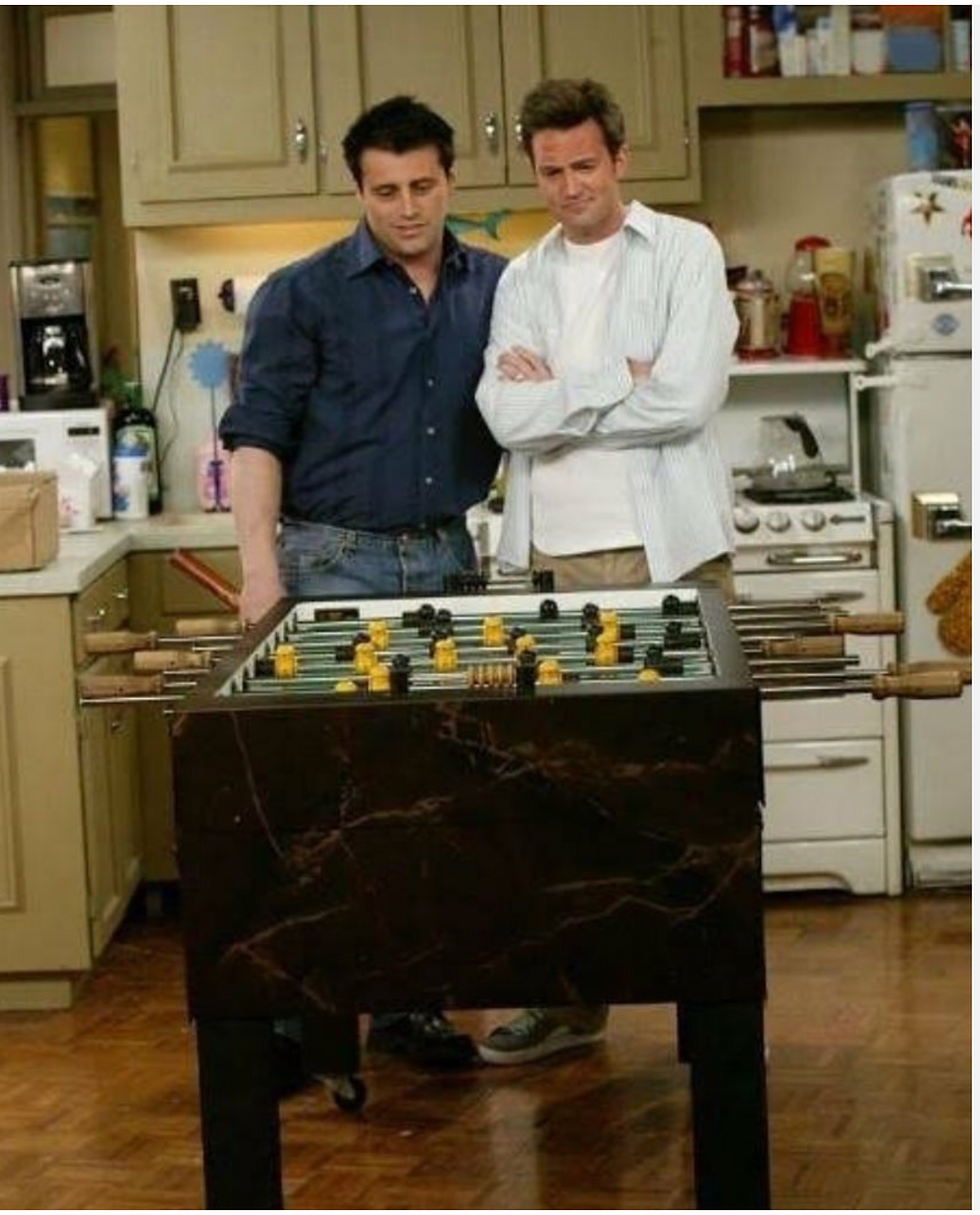
When objects associated with an era or time period are inserted into an environment or time period far apart from their original home it can be an occasion of spectacle or curiosity just like Joey and Chandler’s foosball table in the (very) 1990s show Friends.
Yet all art objects concerned with a particular age, indeed all the many mentioned in this blog post, are always already reflecting upon, wrestling with, arguing with, and harkening and dreaming back the age that is the object of interest. One of the teen character in Dazed And Confused offers her comprehensive theory of history:
“It’s like the every other decade theory. The 50 were boring, the 60s rocked, the 70s Oh my God they obviously suck - maybe the 80s will be radical.”
The line makes for a good joke as it will feel quite opposite for the audiences for the 1993 picture, who, having just left the 1980s and the memory of the Reagan revolution and all the talk of its ostensible conservatism, might not agree with that character’s prediction. When I attended the premiere of that picture that line got so much laughter that it extended and covered over whatever the audio was for the next 20 seconds. People have not usually put “radical” and the 1980s together in their definitions of that decade. (Reagan and his followers certainly saw themselves as conservatives and as opponents of what they perceived to be any kind of radicalism). Yet today it is practically an industry to write nonfiction books telling us that the 1980s were actually a time of a kind of radicalism that changed all the many rules that had governed the economy for much of the 20th century. And though the 1970s sucked for that character even those ten years did not suck for all of us. The adjective “obvious” can of course be its own “weasel” word.
Consensus over the evaluation of any era can seem an impossible dream. There is currently no era more divisive and fought over in terms of how it is to be remembered than the decade in which that film was made of the 1990s. Chuck Klosterman might say that in his The Nineties that the 90s were “a good time to be president” and Clinton a “president for good times.” But that of course leaves out the verdict of the many millions, becoming increasingly more right wing in sensibility in those years, for whom the Clintons themselves and the entire era are seen as the villainous causes of all our current disasters. And 1990s bashing is one of the very few pastimes shared by the Left and Right. The 1990s were at one and the same time an Era of relative prosperity, even affluence, amidst an epidemic of lost jobs and industries across the United States.
One of the assertions we can safely make about at least the post 2010 Era ( I am tempted to include the first decade of the century as well and not only because of September 11) is that it is an era of intense and emotional drama, of one disruption and cataclysm after another, that it is an era where there is relish in destruction of all kinds - a whole company and industry integral to our era had as their motto “move fast and break things”. But even this assertion is complicated by the relative constancy and sameness of aesthetics and design amidst all the tumult as if all our drama demands an undramatic and even static design if we are to be destructive and dramatic in action.
Kurt Anderson in his book Evil Geniuses is one of those public intellectuals who is at least trying to make sense of our period. He contrasts the regular and dramatic changes that would mark every ten to twenty years in much of the 20th century with the relative stasis of the recent past as it appeared to him in 2020:
“Reading the Times one morning in 2007, I came across a revelatory photograph in an article about Ian Schrager and Steve Rubell, the supreme New York discotheque impresarios who then became inventors of the boutique hotel. The picture was from twenty-two years earlier, in 1985 when they’d posed with some of the young staff at Morgans. Their cool-old-fashioned-but-cutting-edge Manhattan prototype.”
Anderson continues
“Shrager’s collarless shirt looked somewhat retro, but I was otherwise struck by the fact that none of the dozen people in this very old picture appeared obviously amusingly dated, not their clothes, not their hairstyles, not the women’s makeup. If any of them had walked by me on the street that afternoon, I wouldn’t have given him or her a second look. They could have all passed for contemporary people. Suppose in 1997 I’d look at a similar photo taken in 1975. Or watch a 1970s movie or TV show…the jangly music, the luxuriant sideburns and hair, the bell-bottoms and leisure suits the cigarettes and avacado-colored refrigerators and AMC matadors and Gremlins everything and everyone would have looked so different and dated.
“No more. Now people drove new Nissans and Infinitis that looked practically identical to the Nissans and Infinitis from a generation earlier. They sat in new Aeron chairs exactly like the new Aeron chairs people had sat in ten years earlier.”
He even tried to conduct experiments for his idea.
“I conducted taste tests among people my age and in their forties thirties and twenties. I played them new pop songs that weren’t big hits and showed them clips of unfamiliar movies and photos of recent buildings and cars asking them when they thought each had been created. Almost nobody could definitively say that the things from 2007 weren’t from 1997 or 1987”.
Perhaps we will always disagree over the newness or oldness of any event or setting in which we find ourselves. Just as many say that a thing is unprecedented as say, often in the manner of a scold, that “we have been here before”. Discussion never abates over which new public event is actually like this or that event in the recent or distant past or which era we most or least resemble.
That William Faulkner quote that people like to enlist in so many discussions of this kind reads in its full actuality:
“The past is never dead. It's not even past. All of us labor in webs spun long before we were born, webs of heredity and environment, of desire and consequence, of History and eternity. Haunted by wrong turns and roads not taken, we pursue images perceived as new but whose providence dates to the dim dramas of childhood, which are themselves but ripples of consequence echoing down the generations.” (Requiem For A Nun)
The quotidian demands of life can appear to distract from this resonance of images and events with which me must live in every moment. Such a great part of our lives is designed by somebody is precisely not ready made and found and some of us will feel the power and full of any era more than others. Perhaps one reason why humans invented things like world of Art is as a way to manage and sort out these questions of where we have been, where we are and where we might find ourselves in a given future.

#sicily #italy #1960s #burtlancaster #claudiacardinalle #costume #setdesigner #artdirector #design #producer #iatse #film #television #1980s #1970s #aersomith #fashion #madmen #johnhamm #danielmendelsohn #newyorktimesbookreview #johnslattery #dazedandconfused #friends #jenniferaniston #lisakudrow #davidschwimmer #matthewperry ricklanklater #recreationhall #sports #parkerposey #mattmcconaughey #jasonlondon #wileywiggings #luchinovisconti #marssaribisi #millajovovich #kiss #peterframpton #framptoncomesalive #texas #bicentennial #1976 #america #geraldford #bettyford #baseball #airhocky #foosball #danceclub #unitedstates #marijuana #beer #football #foghat #christinahendricks


Brilliant !